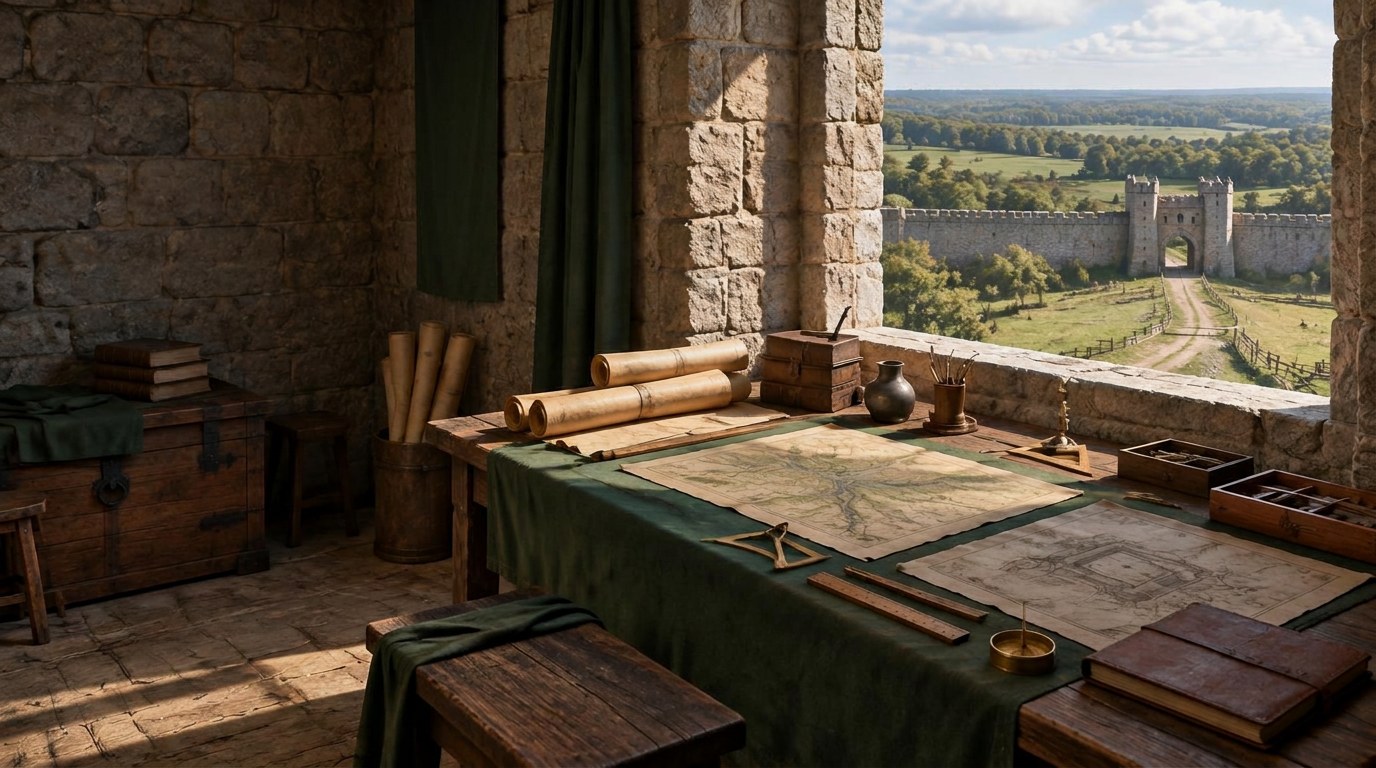
Forest-green research post overlooking an English gate and countryside
The Castle / Institutions

The discovery post

PARTIAL

Canonical institution

Scout Wing

Close to the outer field approach / Scout Gate.

Discovery, business grounding, website inspection and legitimate contact routes — assembled into evidence, not sales instructions.

Viewing window · field notes · routes · timberInstitutional study

01 / The responsibility

What this room means

Scout Wing discovers potential businesses and establishes enough reliable truth for Castle to decide whether they are worth approaching. Unknown territory becomes a discovered candidate, a grounded business, an inspected digital presence, a usable contact route and an evidence-rich Prospect Dossier. It is Castle’s acquisition-and-evidence institution, not its sales-writing department.

In the real system

Search-territory planning, prospect acquisition, identity, locality and service grounding, public-source evidence, Website Quality inspection, contact discovery and recovery, provenance, dossier assembly and coverage or yield-support state. Scout’s completed product is a valid evidence-backed downstream state. Scout establishes what Castle knows; Outreach decides what legitimate commercial use may be made of that knowledge.

The institution question

“What do we actually know about this potential prospect, and is that evidence strong enough to hand downstream?”

  1. 01Outside World
  2. 02Scout Gate
  3. 03Scout Wing
  4. 04Outreach Office

02 / At the gates

Work entering. Work leaving.

Work entering

  • Research scope and business priorities
Scout Wing

The Scout evidence flow

  1. 01Scout Cartographer
  2. 02Scout Pathfinder
  3. 03Scout Investigator
  4. 04Scout Website Inspector
  5. 05Scout Tracker where contact work is required
  6. 06Dossier Clerk
  7. 07Prospect Dossier leaves Scout Wing

Each stage must produce the evidence or state required by the next. The flow is not rigid where evidence already exists: with a trustworthy contact route already established, Website Inspector may hand directly to dossier assembly without redundant Tracker work.

  • Field Runner moves bounded work between stages.
  • Map & Survey Aide supports the Cartographer with coverage and yield state.

Operating principle

Discovery creates candidates; evidence supports qualification.

03 / The roster

The character register

Durable roles. Defined authority.

Evidence & acquisition desks

Primary Scout chain

Five cognitive roles establish where to search, which businesses to investigate, what is true, how the website works and which contact routes are legitimate.

SCOUT-01Canonical portrait to be added

SCOUT-01 / CANONICAL

Scout Cartographer

Decides where Scout effort should be directed, considering geography, trades, previous coverage, inventory demand and available yield evidence.

Castle action

Studies territories, towns and previous search work, then defines where Scouts should search next.

In the system

Market and search-territory planning: reasoning about search space, attempted or exhausted territory and historical yield, with downstream conversion feedback where available.

Canonical question

“Where should Scout search next?”

Authority boundary

Owns search-plan reasoning, not the discovery of individual businesses.

SCOUT-02Canonical portrait to be added

SCOUT-02 / CANONICAL

Scout Pathfinder

Acquires new candidate businesses from the outside world for investigation.

Castle action

Leaves Castle, searches the assigned territory and returns with newly discovered businesses.

In the system

Prospect acquisition and candidate discovery: open-web search, domains and URLs, preliminary business data, source admission, deduplication and acquisition cadence for forward inventory.

Canonical question

“Which businesses might be worth bringing back for investigation?”

Authority boundary

Owns raw candidate discovery, not full business grounding.

SCOUT-03Canonical portrait to be added

SCOUT-03 / CANONICAL

Scout Investigator

Establishes who a discovered business actually is: identity, locality, services, trading evidence, official presence and relevant public facts with provenance.

Castle action

Receives a candidate from Pathfinder and establishes factual business identity, including whether it matches the intended business type.

In the system

Research and business grounding: reliable public-source facts, distinguished from assumptions and uncertainty.

Canonical question

“Who is this business, and what is genuinely true about it?”

Authority boundary

PATHFINDER DISCOVERS. INVESTIGATOR ESTABLISHES FACTS.

SCOUT-04Canonical portrait to be added

SCOUT-04 / CANONICAL

Scout Website Inspector

Establishes the truth of a prospect’s digital presence, including function, mobile experience, usability, services, trust presentation and the contact or enquiry journey.

Castle action

Enters the merchant’s digital shopfront and records what is actually there, including credible improvement opportunities.

In the system

Website Quality / WQ analysis: whether a site exists, how it works and what its customer experience genuinely supports.

Canonical question

“What can Castle truthfully say about the current website experience?”

Authority boundary

Inspect the actual experience; do not manufacture criticism so Castle can sell.

SCOUT-05Canonical portrait to be added

SCOUT-05 / CANONICAL

Scout Tracker

Establishes a legitimate, evidenced route to the relevant business or person.

Castle action

Follows contact trails until Castle has a trustworthy contact route, recovering alternatives when an address is bad or has bounced.

In the system

Contact discovery, provenance and recovery: professional emails, company inboxes, phone numbers and alternative routes, distinguishing merchant contacts from platform contacts.

Canonical question

“How can Castle legitimately reach this prospect, and what evidence supports that route?”

Authority boundary

Owns contact-route evidence, not writing or sending outreach.

Institutional machinery & state

Supporting Scout roles

Bounded work movement, dossier assembly and territory-support state make the primary chain usable. Supporting responsibility is distinct, not unimportant.

SCOUT-06Canonical portrait to be added

SCOUT-06 / CANONICAL

Field Runner

Represents movement of bounded work between Scout stages: candidate IDs, research tasks, evidence packets, transitions and handoff state.

Castle action

Carries notes, evidence and business material between Scout specialists.

In the system

Workflow / queue plumbing. The underlying handoff function exists through workflow plumbing; the full canonical role is not independently implemented.

Canonical question

“Has the right Scout work packet reached the right next desk?”

Authority boundary

Representation as a person does not imply an independent reasoning brain.

SCOUT-07Canonical portrait to be added

SCOUT-07 / CANONICAL

Dossier Clerk

Assembles verified Scout material into one usable downstream Prospect Dossier, preserving evidence, uncertainty and relevant workflow state.

Castle action

Gathers the Scouts’ verified material into an orderly dossier before it leaves Scout Wing.

In the system

Prospect-record assembly: business identity, research findings, website observations, contact provenance and source evidence brought together in a complete downstream record.

Canonical question

“Is Scout’s verified material assembled into a usable downstream record?”

Authority boundary

Owns completeness and assembly, never inventing evidence to make the dossier appear complete.

SCOUT-08Canonical portrait to be added

SCOUT-08 / CANONICAL

Map & Survey Aide

Maintains structured territory-support state for the Cartographer: attempted areas, category and location combinations, expedition outcomes and coverage or yield information.

Castle action

Updates expedition maps, survey notes and coverage records.

In the system

Search-coverage and yield-support data. Some coverage and search-state concepts exist; the full canonical support role remains future implementation.

Canonical question

“What territory has Scout already covered, and what happened there?”

Authority boundary

Owns structured support state, not strategic territory choice.

Evidence / Downstream handoff

Dossier Clerk → Outreach Intake Clerk

Scout does not hand Outreach an instruction to sell. Scout hands Outreach a factual record.

Source
Scout Wing / Dossier Clerk
Target
Outreach Office / Intake Clerk
Entity
Prospect
Current state
Grounded Scout qualification state
Evidence
Research, website observations, contact provenance and source material
Requested action
Determine whether legitimate commercial correspondence should be prepared
Authority state
Evidence complete enough for Outreach intake, NOT permission to dispatch
Return condition
Outreach accepts the dossier or returns a specific missing-evidence defect

Repair / Resubmission

Backward handoffs are valid

  • Website Inspector → Investigator

    Business identity is unclear.

  • Tracker → Investigator

    The contact appears to belong to another entity.

  • Dossier Clerk → relevant Scout specialist

    Required evidence is missing.

  • Outreach Examiner → Scout

    A commercial claim cannot be grounded.

A returned packet states why it was returned, what is missing, who owns the repair and what allows resubmission.

Authority / The boundary

Evidence is not permission

Scout may

Search, investigate, inspect, discover contact routes, preserve provenance, report uncertainty, assemble evidence, reject weak candidates and return incomplete work.

Scout may not

Invent favourable facts, downgrade uncertainty to increase pipeline volume, write unsupported outreach claims, negotiate terms, send correspondence, declare payment or customer state, or alter another institution’s specialist truth.

HOTK may increase Scout priority, but may not lower its evidential standard merely to fill a queue. Campaign urgency does not change what Scout may call true.

04 / Supported roads

Connections

Business estates

Castle-wide capability. Estate-specific relationships are being added.